What if the retention risk you're missing is the one costing you the most?


Experienced employees are leaving without warning
Working with senior leaders to show who's at risk and why.


See what your data isn't showing you
Find the retention risks hiding in plain sight.

Understand what's actually driving it
Looking beyond your WGEA data.

Know what it's costing and what to do about it
Evidence-based analysis with a clear path forward.

You're doing the right things on gender equity.
And your experienced women are still leaving.
Your organisation tracks headcount.
You report to WGEA.
You have policies and strategies in place.
None of it tells you who is about to leave.
The women who have been there the longest carry institutional knowledge, client relationships, and team capability.
They are also the most likely to disengage or 'quiet quit,' and WGEA reporting was never built to catch it.
Some leave. Others stay but stop giving you their best, potentially for years.
These are women who, often for the first time in decades, have more energy, more focus, and more to give.
Their caregiving loads have shifted.
They know exactly what they're capable of.
And most organisations haven't noticed.
We've done the research.
We know what's driving this.
Meridian Shift was built on a simple observation: Australian organisations are investing in gender equity and still losing their most experienced women because no one is looking at this cohort specifically.
We bring the evidence, the frameworks, and the strategies to give your leadership team the clarity to act.

The cost is almost certainly higher than you've considered.
Most organisations underestimate this because they only count recruitment.
The real cost runs deeper.
The Retention Intelligence Calculator builds an evidence-based estimate of:
what you're likely losing across recruitment and onboarding,
the productivity gap while a replacement gets up to speed,
the institutional knowledge and client relationships that leave with her,
the mentoring burden placed on the team left behind, and
the extended period your role sits vacant in a tight labour market.
Every figure is based on your organisation's size, sector, and attrition rate: giving you a credible, evidence-based starting point for a conversation your leadership team needs to have.
Every one of those figures represents someone who was still capable of more
but no longer had a reason to stay.
Here's how it works
Stage One - The Retention Calculator
1. Identify
Using the free Retention Calculator to evaluate your potential risk, cost and gaps
is the first step to considering whether you need to look more closely.
Stage Two - The Retention Scan
2. Gather
A template is provided for you to gather key metrics and information.
3. Analyse
We make sense of what the data says, identify if you are likely to have a retention gap and gauge what it might be costing you.
4. Review
We work with your leadership team to decide if this is a gap that you want to address. Your next step includes a structured and detailed process to develop a specific ongoing strategy.
The Retention Scan
You've seen what it might be costing you. Now let's find out what it actually is.
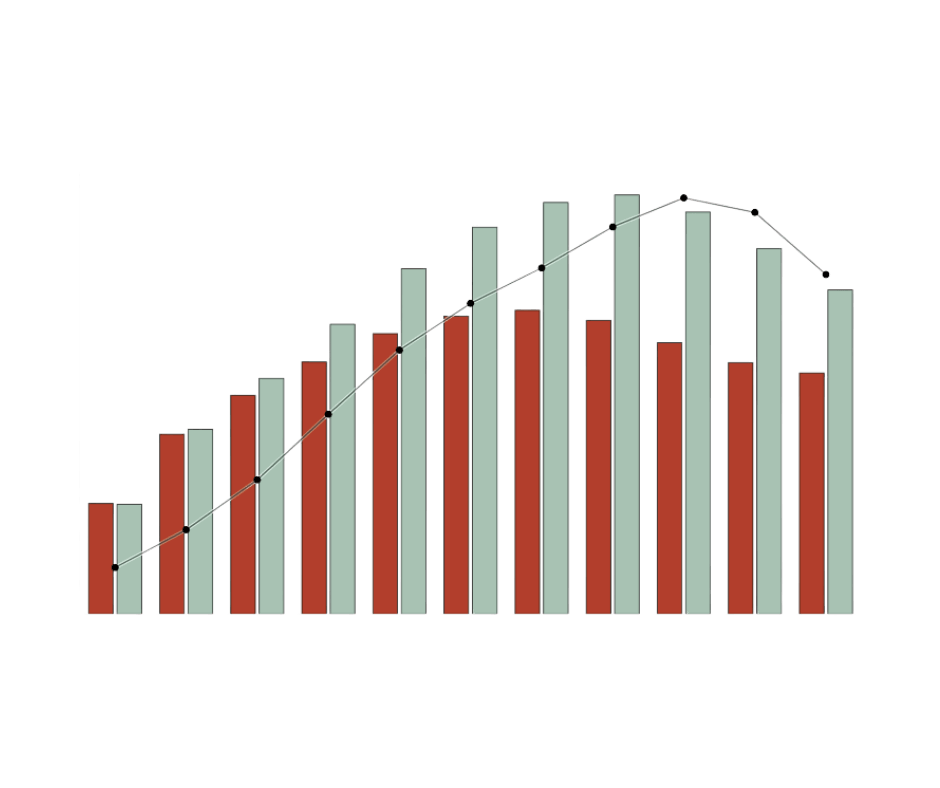
Every year without this data is another year of workforce decisions made blind. Your experienced women are still leaving.
The Retention Scan tells you what your WGEA report doesn't:
a structured audit of your workforce data;
a findings report with indicative cost exposure; and
a clear picture of where the gap is.
Contained scope.
Defined timeframe.
Evidence you can act on.
You'll know exactly who's at risk, why, and what it's costing you.

Kathleen Fair, Lead Consultant
Kathleen Fair spent thirty years in executive health leadership watching capable, experienced women burn out, check out, or walk out. She left that career wanting to help those women directly. What she found was that the picture was more complicated than that.
Midlife reshapes what people want from work: energy, focus, goals, what feels worth doing and what no longer does. Most organisations have neither the data nor the language to recognise that shift, let alone respond to it. The cost shows up in turnover, in knowledge loss, in culture, and in the gradual disappearance of the women others in the organisation were watching and learning from.
This work makes that visible, and gives organisations the tools to act on it.
F.A.Q.s for Organisations
The retention blind spot is the gap between what your gender compliance data shows and what is actually happening to experienced women in your organisation.
It exists in most Australian organisations with over 100 employees, because the metrics most commonly used do not segment exit data by age and gender together.
To find out whether you have one, you need to look at voluntary turnover rates for women aged 40 to 60, track that against men in equivalent roles and tenure, and model the cost.
Most organisations have never done this analysis. When they do, the picture is rarely as healthy as the compliance dashboard suggests.
Standard gender equity metrics are designed to measure the hire side of your workforce, not the exit side. WGEA reporting and most DEI frameworks capture headcount parity and pay gap data at a point in time. They are age-agnostic, meaning a 28-year-old woman and a 52-year-old woman count identically in your data.
An organisation can appear fully compliant while systematically losing its most experienced women in the 40 to 60 cohort, and the compliance data will not show that pattern.
This is not a criticism of WGEA frameworks. It is a design limitation: the metrics were built to solve a different problem.
WGEA compliance reporting captures gender representation, pay equity, and some measures of workplace flexibility.
What it does not capture is the experience of women who remain employed but have quietly checked out, women who leave after years of service in their peak-contribution years, or the organisational cost of losing institutional knowledge and senior-level capability.
The data is hire-side and point-in-time. Exit data segmented by age cohort is not required.
WGEA-compliant organisations can therefore carry a serious retention problem that is invisible in their reporting, and many do.
Research from McKinsey, Gallup, and Deloitte's Women at Work report consistently shows that disengagement precedes departure by months or years.
For women in the 40 to 60 cohort, the triggers tend to be structural: being passed over for roles based on untested assumptions about ambition or availability; being assigned non-promotable tasks at a higher rate than male peers; a lack of sponsorship (different than mentorship); and an absence of visible role models at senior level.
HR Leader's Australian research published in early 2026 describes this as 'quiet checking out', noting that these women rarely register as flight risks in standard workforce metrics. Their eventual departure is classified as a career break or personal reasons rather than preventable attrition.
The cost of that disengagement, through presenteeism and reduced contribution before they leave, rivals the cost of the turnover itself.
AHRI benchmarks the true cost of replacing an employee at up to 1.5 times annual salary. For senior roles this figure is conservative: it covers recruitment, onboarding, and productivity loss during transition, but does not capture the institutional knowledge that leaves, the client relationships, the mentoring relationships she held, or the signal her departure sends to other women in the organisation.
Australian employee turnover costs businesses $3.8 billion annually across the first year of employment alone. For organisations with 500 or more employees, conservative modelling using these benchmarks suggests significant uncosted talent risk sitting in the 40 to 60 women's cohort.
Meridian Shift's diagnostic tool provides a preliminary cost estimate based on your organisation's size, sector, and turnover rates. All estimates should be treated as indicative and subject to formal audit.
Yes, and it is increasingly documented as a workforce retention issue, not only a health one.
The 2024 Australian Senate Inquiry into perimenopause and menopause confirmed this. MetLife Australia data shows 14 percent of Australian women have left the workforce entirely due to menopause symptoms. Menopause is one of several intersecting midlife factors that organisations currently have no data infrastructure to track or respond to.
The Meridian Shift lens sits at the structural level underneath: why organisations systematically lose experienced women in this cohort, of which menopause is one contributing factor alongside others.
Organisations carrying this work in depth include Menopause Friendly Australia and Diversity Council Australia.
Organisations with strong retention of women in the 40 to 60 cohort share several characteristics:
they track exit data by age and gender together;
they have visible senior women in their 50s in non-token roles;
they have explicit sponsorship programs rather than mentoring-only programs; and
they have identified and removed structural barriers including non-promotable task loading and proximity bias in performance review processes.
The McKinsey longitudinal research is clear: the ambition gap between men and women disappears when women receive equivalent support. The gap is structural, not motivational.
Organisations that treat it as a structural problem get measurably better retention outcomes.
The Invisible Middle research report draws on:
WGEA gender equity data,ABS labour force statistics,AHRI workforce benchmarks,CEPAR research on mature-age workforce participation,the McKinsey and LeanIn Women in the Workplace longitudinal study,Deloitte Women at Work annual survey data,Gallup workplace engagement research, andthe Commission for Gender Equality in the Public Sector (Victoria).
The full referenced report is available on request.
WGEA reporting with respect to women in the workplace focuses on one main issue- increasing the number of women (across all levels). It does not address keeping the women already working with you.
This is where Meridian Shift assists. You may already be meeting your targets with respect to women in your organisation. With a structured investigation and facilitation of honest conversations we are able to provide methods for understanding the skills and knowledge that may be underutilised, and identify the women most at risk of disengagement or resignation.
You are making workforce decisions without having all of the relevant data.
Let's change that.
© 2026 Meridian Shift.
All rights reserved.
Bendigo, VIC, Australia
Subscribe here for free
We HATE spam. Your email address is 100% secure